
When FOIL Appeals Disappear: A Procedural Gap in New York’s Transparency Law
Executive Summary
A review of a Village of Fairport Freedom of Information Law matter documents a transparency mechanism that FOIL does not adequately address: the administrative appeal that produces no record.
Under New York’s Public Officers Law, an agency that fails to issue a written appeal determination within ten business days is deemed to have denied the appeal by operation of law. The requester may then proceed to court. What the statute does not require, however, is that the agency produce any written record of that outcome.
This produces a category of FOIL outcome that is formally cognizable — a denied appeal — but practically invisible.
This piece uses the Fairport matter to examine how that gap functions and what it means for the practical operation of New York’s transparency law.
The Statutory Framework
New York’s Freedom of Information Law, codified in Article 6 of the Public Officers Law, establishes a layered system for public access to government records. Agencies must respond to initial requests within defined timeframes. A failure to respond constitutes a constructive denial, and a requester may file an administrative appeal.
Under Public Officers Law § 89(4)(a), the agency’s designated appeal body must issue a written determination within ten business days, stating the reasons for any denial. If no determination is issued within that period, § 89(4)(b) treats the appeal as denied, and the requester may seek judicial review under Article 78.
The statute thus contemplates two distinct kinds of appeal denial: an explicit written denial, which includes the agency’s reasoning and is subject to review; and a constructive denial by inaction, which carries no documentation requirement at all.
That asymmetry is the structural gap.
Case Example: Village of Fairport
Transparent Law Enforcement submitted a FOIL request to the Village of Fairport on December 3, 2025, seeking disciplinary records, and a second request on February 24, 2026, seeking employee roster and ADA contact information. Neither request received an acknowledgment within the statutory period.
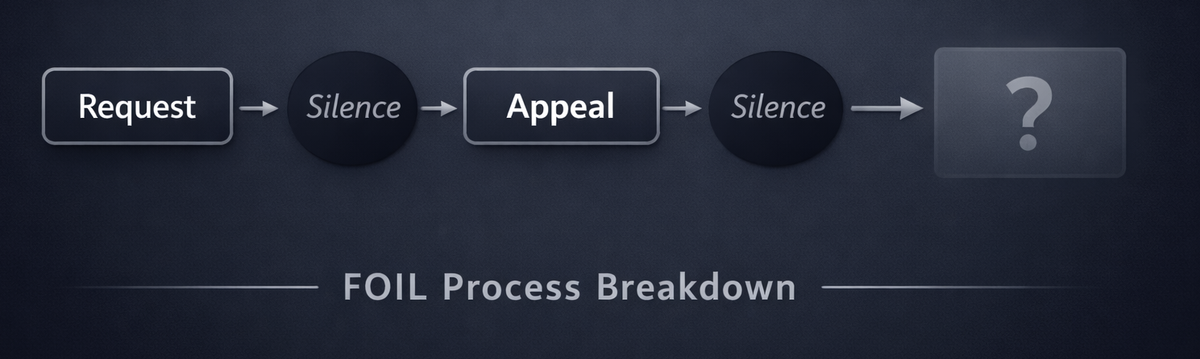
On March 13, 2026, TLE filed administrative appeals covering both unacknowledged requests. Ten business days elapsed. No determination was issued on either appeal.
Under Public Officers Law § 89(4)(b), both appeals are deemed denied.
No written denial exists. No exemption was cited. No agency reasoning was provided. No record of either appeal outcome was created.
Procedural Consequence: Article 78 as the Only Remedy
Under Public Officers Law § 89(4)(b), once an administrative appeal is deemed denied, the requester’s only remaining avenue is judicial review through an Article 78 proceeding.
That transition represents a significant procedural shift. The administrative appeal process is designed to be accessible: it requires no filing fee, no formal pleading, and no legal representation. An Article 78 proceeding, by contrast, is a court action initiated in New York State Supreme Court. It carries filing costs, service requirements, and procedural rules that are not part of FOIL’s administrative framework.
In addition, where an agency issues a written denial, the requester enters that process with a defined record — a stated rationale, identified exemptions, and a document subject to review. In the case of a constructive denial by inaction, no such record exists. The requester proceeds without knowing the basis for the denial or whether any exemptions have been asserted.
The statute permits this transition without requiring the agency to produce a written explanation at the administrative stage.
The Structural Gap
This sequence reveals a gap in FOIL’s practical operation that the statute has not resolved. FOIL requires a written appeal determination but does not ensure one is issued. It assumes that appeal outcomes will be visible but does not guarantee a record is created.
The statute thus produces a final administrative outcome without ensuring that the outcome is documented.
When an agency neither responds to a request nor determines the resulting appeal, the outcome is a denial without a record of the denial — formally real, practically untraceable.
An agency that issues a written denial creates a document. That document names an exemption, attributes the decision to an agency officer, and can be reviewed, cited in litigation, or examined by a journalist or researcher. An agency that allows the appeal period to expire without acting produces something different: a legal conclusion with no underlying record.
The denial is real — a requester cannot simply re-file and restart the clock — but it leaves behind nothing accessible through normal public records channels.
In practice, this produces a denial that cannot itself be FOILed.
Impact on Transparency
The consequences of this gap compound across the system.
The New York State Committee on Open Government’s oversight function depends on the existence of appeal determinations to review. Under Public Officers Law § 89(4)(a), agencies are required to forward copies of appeal determinations to the Committee. This mechanism allows COOG to observe how agencies apply exemptions and to identify patterns in FOIL compliance.
That mechanism depends on the existence of a written determination.
When an agency issues a written denial, a document is created and can be transmitted, reviewed, and incorporated into COOG’s understanding of FOIL practice. When an agency does not respond to an appeal, no determination is produced and nothing is forwarded.
As a result, a category of FOIL outcomes — appeals denied by operation of law — may not be reflected in the materials available to COOG through this process.
Internally, written determinations are sometimes copied to municipal counsel or supervisory officials, creating at minimum an administrative trail. Constructive denials generate no equivalent record, meaning a pattern of appeal inaction may be invisible not only to the public but to the agency’s own oversight structure.
The burden on the requester shifts correspondingly. FOIL’s appeal mechanism is designed to place the obligation on the agency — to respond, to explain, to justify a denial. When an agency does neither, that burden effectively reverses. The requester must track statutory deadlines, recognize that a constructive denial has occurred, and determine whether to pursue judicial review.
For many requesters, that threshold is difficult to meet.
If this pattern repeats across matters, the cumulative effect is that an entire category of FOIL appeal outcomes leaves no visible trace in the public record.
Structural vs. Strategic
This analysis does not assert that the Fairport matter reflects deliberate strategy. The record does not support that conclusion, and this work does not treat unexplained absence as evidence of intent.
What the record does show is that the structure of FOIL permits this outcome regardless of intent. An agency that misses the ten-business-day window due to administrative oversight produces the same result as one that deliberately allows the deadline to pass.
The public record cannot distinguish between them.
That indistinguishability is itself the problem — and it is a problem the statute has not addressed.
Implications
FOIL’s value depends not only on access to records but on visibility into how agencies handle requests and appeals.
Written denials, whatever their limitations, are themselves a form of disclosure. They show what agencies are withholding and why.
Constructive appeal denials do not. Instead it is a denial without a record of the denial — a FOIL outcome that cannot itself be obtained through FOIL.
They remove a category of FOIL outcome from view at precisely the stage where the statute is designed to provide accountability — after an initial failure to respond has already occurred.
A reform requiring agencies to issue even a brief written determination, or a formal acknowledgment, upon expiration of the appeal period would close this gap without altering the underlying legal outcome for the requester.
The denial may remain. The absence of a record should not.
About This Review
This article is part of Transparent Law Enforcement’s ongoing documentation of procedural patterns in public records compliance across Monroe County and the surrounding region.
The underlying FOIL matters referenced here remain open.