
The Background Check: How Rochester Police Investigate Their Critics
Rochester Police disciplined an officer with 30 minutes of training—then requested an MCAC intelligence “work-up” on the complainant. No written policy explains why.
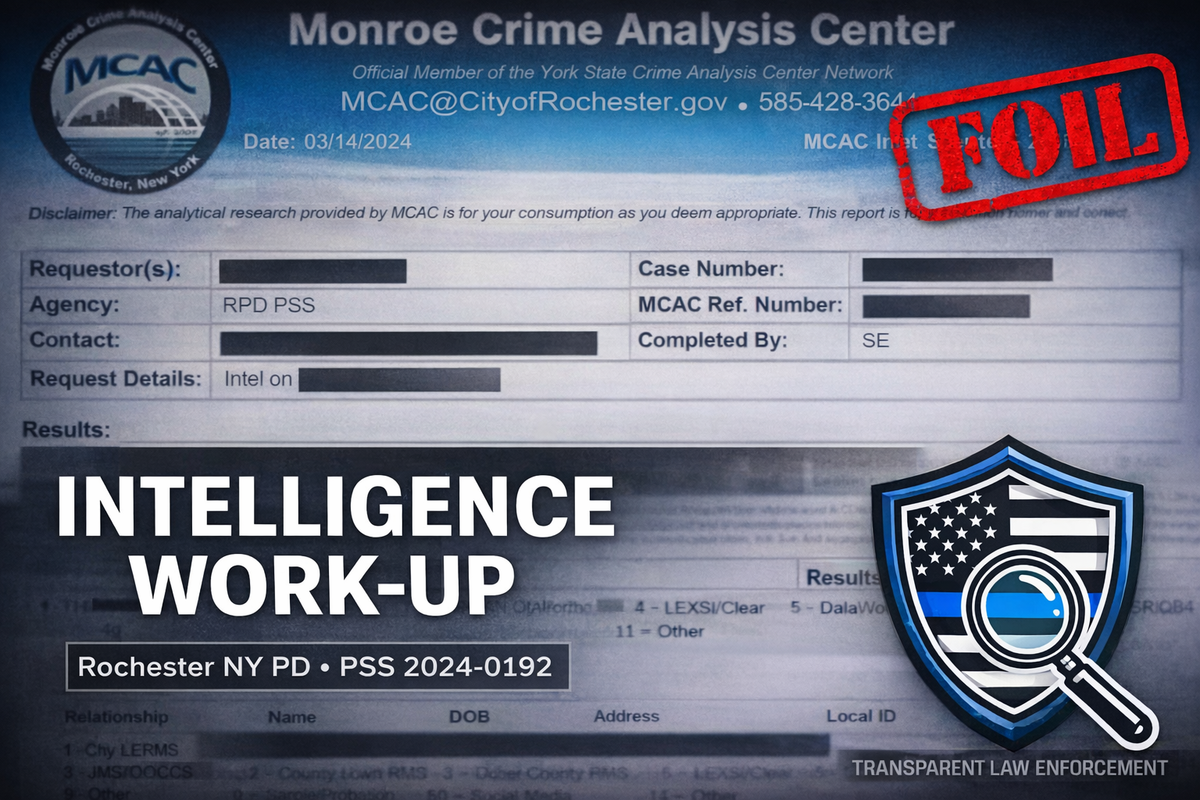
An examination of Professional Standards Section Case 2024-0192
Transparent Law Enforcement — February 2026
Executive Summary
On March 13, 2024, Ms. Wright gave Rochester Police Officer Rafael Rivera the middle finger. Officer Rivera gave her the middle finger back and yelled a vulgarity. When Ms. Wright asked for his name and badge number—as required by department policy—Rivera refused to provide it.
Ms. Wright filed a complaint. Rivera later admitted two policy violations: failing to identify himself when requested, and discourteous conduct. The outcome was minimal: a training referral and 30 minutes of additional instruction.
But the complainant’s treatment followed a different track. The day after Ms. Wright filed her complaint, Rochester Police requested an intelligence “work-up” on her through the Monroe Crime Analysis Center (MCAC). That work-up ran Ms. Wright through multiple law-enforcement and commercial databases—gang database queries, criminal intelligence file checks, mental-health/overdose history checks (as labeled by MCAC), and a commercial background search that mapped relatives and associates.
When Transparent Law Enforcement requested written policies governing when Professional Standards investigators may run complainants through those systems, Rochester Police certified no responsive policies or training materials existed. The department later produced a detailed Professional Standards Section (PSS) manual that prescribes extensive investigative steps for citizen complaints, but contains no written standards for intelligence-style background checks on complainants.
Whether that silence is intentional or not, the effect is the same: investigators can subject complainants to broad intelligence queries without a written framework defining when such searches are permitted, what approvals are required, what justifications must be documented, or what limits protect the public from retaliatory scope creep.
About This Examination
This analysis is based entirely on documents obtained through New York’s Freedom of Information Law, including Professional Standards Section investigative files, policy manuals, MCAC intelligence records, and IAPro audit logs. It does not include interviews with Ms. Wright, Officer Rivera, or RPD personnel beyond what appears in the official investigative record. All quotes are from official documents. Referenced materials (IAPro logs, MCAC intel sheets, interview transcripts, policy manual chapters) are available as appendices.
Where this analysis draws conclusions (for example, regarding chilling effects), it does so from the documented process and the absence of written constraints—not from speculation about any individual’s intent.
1) Timeline (Key Dates)
- Mar 13, 2024 — Incident and complaint filed (PSS 2024-0192)
- Mar 14, 2024 — MCAC “Work Up Request” submitted for Ms. Wright
- Apr 2, 2024 — Stenographic interview with PSS
- Aug 8, 2024 — Supervisor memo documents Rivera meeting and policy expectations
- Aug 19, 2024 — Rivera stipulates guilt to identification + courtesy violations
- Sep 13, 2024 — Rivera completes 30 minutes of training
- Dec 5, 2025 — TLE FOIL requests policies/training and logs for PSS intelligence queries
- Feb 5, 2026 — RPD produces PSS manual and IAPro audit log materials for the case
2) The Incident
On March 13, 2024, at approximately 10:30 AM, Ms. Wright encountered Officer Rafael Rivera while walking on East Avenue in Rochester. Ms. Wright gave Rivera the middle finger. Rivera returned the gesture and yelled “go fuck yourself.”
Ms. Wright approached Rivera’s patrol vehicle and asked for his name and badge number. Rivera refused. Ms. Wright returned to her office at 350 East Avenue and filed a complaint with the Professional Standards Section.
Ms. Wright’s gesture—an insult directed at a police officer—falls within clearly recognized First Amendment protection, including Second Circuit precedent holding that a middle-finger gesture toward police is not reasonable suspicion of a crime. Ms. Wright made that constitutional framing explicit in writing, citing Swartz v. Insogna (2d Cir. 2013).
During the PSS interview, Sgt. Nickolas Isler called Ms. Wright’s gesture an “act of lewdness”—a framing that pushes the gesture toward “indecency” rather than treating it as crude political insult. Isler told Ms. Wright he could “see” the gesture if Rivera had personally wronged her—cut her off in traffic, swore at her, beat her up—but because Rivera was “helping someone who was in crisis,” Ms. Wright had done, “in my opinion,” something “no better than what you’re alleging that Officer Lombard did.” Isler then added that Ms. Wright only knew “what the media told you” and did not know “all the facts and circumstances.” Whatever one thinks of Ms. Wright’s protest, the exchange documents an investigator morally adjudicating a complainant’s protected expression rather than keeping the inquiry focused on whether the officer violated identification and courtesy policies.
Ms. Wright’s criticism referenced the widely reported body-worn camera incident involving Officer Lombard and a nine-year-old child.
3) The Officer Investigation and Outcome
The complaint was assigned PSS case number 2024-0192 and designated a “farmout,” meaning it was handled by the officer’s supervisor rather than by PSS directly. Under the PSS manual, farmouts are used for certain categories including discourtesy and improper procedure complaints, with expectations such as interviewing witnesses and documenting officer actions.
On August 8, 2024, Sergeant Andrea Rine documented a meeting with Rivera (with Lieutenant Bing Reaves Jr. present) stating Rivera’s response was unjustifiable and violated the department’s courtesy rule.
On August 19, 2024, Rivera entered a stipulation admitting violations of:
- RPD Rules & Regulations 2.2(a) — Identification: officers must furnish name and badge number upon request when on duty or presenting themselves as police.
- RPD Rules & Regulations 4.2(a)(c) — Courtesy: employees must be courteous and must not use harsh, profane, insolent, or intentionally insulting language toward any person.
Disposition: Referred to Training. Rivera completed 30 minutes of training on September 13, 2024. The training record states he understood the discussion and had no questions.
4) The Complainant Investigation: An Intelligence “Work-Up”
While the officer’s admitted misconduct proceeded through a routine administrative track, the complainant was subjected to an intelligence-style background investigation.
On March 14, 2024—the day after Ms. Wright filed her complaint and before investigators interviewed her—Sergeant Nickolas Isler sent an email to the Monroe Crime Analysis Center requesting a “work up” on Ms. Wright. The subject line was “Work Up Request,” and the body contained no explanation—only Ms. Wright’s name.
MCAC produced an “Intel Sheet” (MCAC Intel Sheet 24-367) documenting checks including:
- City and County law enforcement records management systems (LERMS)
- Gates Impact (neighboring jurisdiction system)
- Gang database queries
- “File 15” / local criminal intelligence file checks
- Jail booking checks
- Vehicle registrations
- Warrants/supervision status
- Mental health transport / overdose history (as labeled by MCAC)
- LexisNexis (commercial background service), including relatives/associates mapping
The work-up reported “very little information,” no wants/warrants, no gang database listing, no supervision status, and “no found MHT/OD history.” The only clear fact it establishes is that the work-up occurred—and that it was requested the day after Ms. Wright filed her complaint.
The question: what is the written policy basis for running complainants through gang databases and commercial background systems in administrative misconduct investigations?
5) What the PSS Manual Authorizes—And What It Doesn’t
The Professional Standards Section manual produced by Rochester Police is detailed and operational. It prescribes step-by-step procedures for complaint investigations, identifies systems to obtain incident materials (such as dispatch “job card” information and incident reports), and lays out timelines and routing requirements.
The manual authorizes familiar complaint-investigation tasks: obtaining incident reports, interviewing complainants and witnesses, collecting photographs, reviewing rosters and logs, and documenting officer accounts. It also describes specialized tools and restrictions (including that polygraph/CVSA may be used on complainants but not officers due to contractual limitations).
But in a manual that is otherwise explicit about forms, systems, and procedures, there is no written framework governing intelligence-style background checks on complainants—no mention of:
- MCAC work-up requests
- Gang database searches of complainants
- Local criminal intelligence file checks as a standard step
- Commercial background checks (e.g., LexisNexis) for complainant vetting
- Mental health/overdose-history checks as investigative practice
- Required approvals, purpose documentation, or audit/review standards for that scope
This matters because the manual demonstrates the department’s capacity to write detailed constraints and workflows. Its silence on complainant intelligence checks leaves investigators with broad discretion and leaves the public without a written standard to evaluate whether such searches are appropriate—or retaliatory.
6) FOIL: “No Records Exist,” Then Production Confirming the Gap
On December 5, 2025, Transparent Law Enforcement submitted a FOIL request seeking (among other items) written RPD policies, procedures, training materials, and guidance governing the use of intelligence systems and commercial background tools (including LERMS/MCAC/Gates Impact/gang database/LexisNexis) in PSS investigations—specifically what authorizes their use, how purpose codes and justifications are handled, what approvals are required, and what audits exist.
RPD certified that no responsive records existed for the requested policies and training materials.
On February 5, 2026, RPD produced:
- the Professional Standards Section manual (multi-chapter), and
- IAPro audit log materials for case 2024-0192.
The produced manual is not evidence that such a policy exists; it is evidence of the opposite: a detailed complaint-investigation framework that does not include written standards for the intelligence checks documented in this case. FOIL leaves two interpretations, both concerning:
- Written guidance exists somewhere but was not produced; or
- No written constraints exist for a practice that includes gang database queries and commercial background mapping of complainants.
Either way, the record supports this conclusion: RPD conducted an intelligence-style background work-up on a complainant in a misconduct case, and the department has not produced written policy explaining when and why such searches are authorized.
7) Why This Matters: Chilling Effect Without Notice or Guardrails
Most people considering a police complaint won’t cite constitutional case law or persist through bureaucratic friction. They’ll decide it’s not worth the risk.
The chilling effect doesn’t require a department to announce, “we will investigate you.” It operates through uncertainty—through the absence of publicly known constraints. Without written standards, complainants cannot know:
- whether filing a complaint triggers intelligence vetting,
- what databases will be searched,
- what information will be collected and retained,
- who will see the results, and
- whether a search can be justified later as “routine.”
The PSS interview adds context to that risk: Isler at one point stated “I’m not allowed to have an opinion,” but elsewhere said: “I will go on record and say that I don’t believe that we should furnish our names to anybody,” predicting that in the “not too distant future” officers may “only furnish a number.” Isler told Ms. Wright he believes officers shouldn’t have to give their names—this while investigating her complaint that an officer refused to give his name and badge number. That’s not proof of retaliation, but it documents an institutional posture that can make filing complaints feel unsafe.
A reasonable person looking at this record can conclude: complaining may put you under an intelligence microscope—without notice, without written limits, and without clear oversight.
8) Conclusion
This case is not just about an officer flipping off and telling a civilian to 'go fuck yourself'. It is about institutional imbalance.
The officer admitted misconduct and received 30 minutes of training. The complainant—whose speech was protected—was subjected to an intelligence “work-up” that included gang database checks, criminal intelligence file checks, and a commercial background mapping of relatives and associates.
The Professional Standards manual shows Rochester Police can write detailed investigative procedures. Yet the department has not produced written standards governing intelligence-style background checks of complainants in administrative misconduct investigations.
That policy gap is the problem. It permits wide discretion with no public rulebook—and it creates exactly the kind of retaliatory risk that deters people from challenging police conduct.
Appendices
- A: IAPro audit log for PSS Case 2024-0192
- B: MCAC Intel Sheet 24-367
- C: Ms. Wright letter to RPD officers
- D: PSS manual — Chapter I (Citizen Complaint Investigations)
- E: PSS manual — Chapter IV (Delegated Assignments / Farmouts)
- F: Stipulation of settlement
- G: FOIL request and “no records exist” certification
- H: PSS interview transcript (Apr 2, 2024)