
Notice of Population-Level ADA Communication Risk – Irondequoit
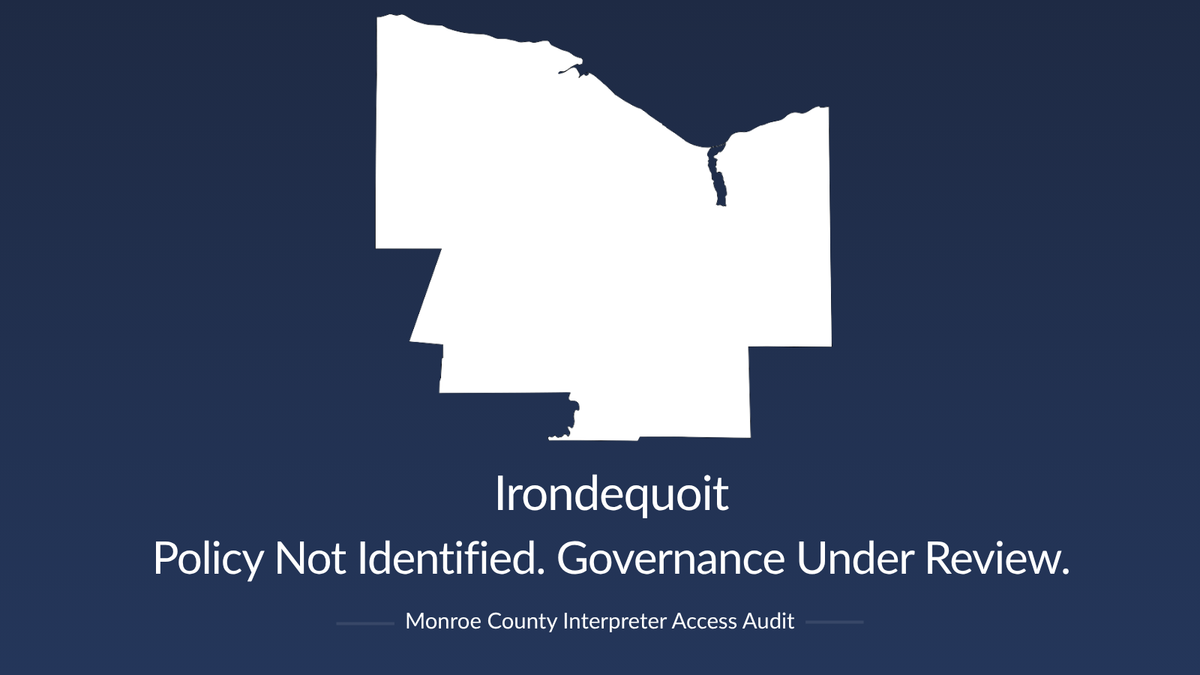
Transparent Law Enforcement has issued a formal notice to the Town of Irondequoit regarding conditions identified through a records-based review of the Irondequoit Police Department’s communication access framework for individuals who are Deaf or hard of hearing.
This notice follows the publication of the Irondequoit Police Department audit as part of the Monroe County Interpreter Access Audit (MCIAA).
The notice is population-level and structural in nature. It is not based on any single incident and does not request enforcement action. Its purpose is documentation of observed conditions relevant to compliance, governance, and risk exposure.
Dear Supervisor Perticone and Mr. Weishaar,
This correspondence provides notice of a population-level ADA Title II effective communication risk identified through a records-based review of the Town of Irondequoit and the Irondequoit Police Department.
This notice is structural in nature. It is not based on any single incident and does not request enforcement action. Its purpose is documentation of observed conditions relevant to compliance, governance, and risk exposure.
Basis of Notice
This notice is based on records produced in response to requests submitted under the New York Freedom of Information Law (FOIL), as well as related correspondence concerning ADA administrative processes.
The review evaluated whether the Town and Police Department maintain a documented and auditable system supporting effective communication with Deaf or hard-of-hearing individuals.
Observed Conditions
- Absence of Documented Police-Specific Communication Framework
The records produced do not identify:
A written policy or directive governing communication with Deaf or hard-of-hearing individuals in police field operations
Procedures for obtaining or deploying interpreters during roadside encounters or investigations
Department-specific training materials addressing communication obligations
The materials produced include general ADA-related training content, but do not demonstrate how those concepts are operationalized within police functions.
- ADA Governance Structure Described as Under Review
Records produced do not identify a formally designated ADA Coordinator or a published grievance procedure.
Correspondence indicates that ADA coordination responsibilities were under review at the time of response, and that the Town Supervisor was identified as a temporary point of contact pending that review.
The materials do not document a defined administrative structure governing ADA compliance.
- ADA Accommodation Request Arising Within Administrative Process
The record reflects a disability-related request for reasonable modification concerning access to Town administrative processes, specifically the ability to submit materials electronically in place of a mail-only submission requirement.
This request:
Remained without a written determination for an extended period
Required multiple follow-ups
Was ultimately addressed after escalation through counsel
The accommodation was eventually granted in part, permitting submission of FOIL requests and appeals via email.
- ADA Issue Embedded Within FOIL Process
The above accommodation request arose within the FOIL process itself, in the course of requesting records related to ADA compliance.
Correspondence indicates that ADA-related requests were not consistently distinguished from FOIL processing during this period, with responses redirecting ADA inquiries to FOIL outcomes rather than addressing them as a separate administrative matter.
This creates a condition in which:
Access to ADA-related records is dependent on processes that themselves may not meet ADA accessibility requirements.
Governance Considerations
Effective communication under Title II is not limited to the availability of auxiliary aids. It also requires a documented system capable of:
Identifying communication needs
Deploying appropriate accommodations
Recording and reviewing those interactions
Based on the records produced, the following conditions are not visible:
A defined operational framework within police functions
A clearly designated administrative structure responsible for ADA compliance
A documented process for handling disability-related accommodation requests
The interaction described above further suggests that ADA-related issues may be addressed on an ad hoc basis, rather than through a structured and auditable system.
Risk Context
Where communication systems are not defined, documented, and consistently applied, risk exposure may arise in several areas, including:
Field encounters requiring timely communication decisions
Administrative processes involving access to public services or records
Post-incident review, where the absence of documentation limits reconstructability
The presence of an accommodation request within the FOIL process highlights the potential for process-level accessibility issues in addition to operational considerations.
Closing
This notice is provided for documentation and awareness. No action is requested in this correspondence.
If the Town maintains policies, procedures, or administrative structures not reflected in the records produced, clarification would be appropriate to ensure that the public record accurately reflects current practice.
Respectfully,
Cadhla McBride
Transparent Law Enforcement
admin@transparentlawenforcement.com
This notice has been provided for documentation and public record purposes. Any clarification or additional materials provided by the Town will be reflected in future updates.